by Tim Gilmore
At dawn, the day before his death, Steve Shultz, chief mate on the cargo freighter SS El Faro, watched the sunrise light the horizon ablaze and recalled offhandedly to the captain the ancient adage, “Red sky at morning, sailors take warning.” Mariners have said it for thousands of years. With the longest wavelength of any visible color, red still pierces the particles of dense and distant storm clouds when no other colors make it through.
 The crew’s information about the storm into which they’d soon steer directly was inconsistent. They didn’t realize that a clerical error had caused them to receive the same storm report twice. The information was 18 hours old and described a system heading north when in fact Hurricane Joaquin was slowly moving southwest. In reality, Joaquin was a nine mile-tall storm engine hovering over the fuel of warm waters. The captain was right when he thought the storm seemed to be “festering.”
In recent years, the 40-year-old, 791-foot-long cargo ship, which made regular runs between Jacksonville and San Juan, Puerto Rico, had fallen into disrepair. TOTE Maritime, the company that owned El Faro, regularly chose profit over safety, and Captain Michael Davidson had learned his lesson when he’d altered course to avoid the last storm system, Erika. He’d earned the displeasure of his employers by adding to fuel and port labor costs by increasing the length of the voyage by 160 miles and five hours, all while Erika fizzled. She never even became a hurricane. Davidson wouldn’t make the same mistake twice.
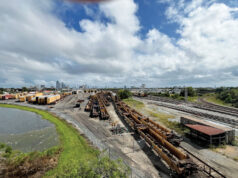
 The El Faro Memorial beneath the Dames Point Bridge seems lonely this September morning, a week and a half before the 10th anniversary of one of the worst maritime disasters in U.S. history, the deadliest in decades. El Faro is Spanish for “the lighthouse,” and the memorial makes for odd dimensions and juxtapositions: a 10 foot-tall lighthouse standing beneath the bridge and covered in graffiti. “Jesus saves,” someone scrawled. “Shaun and Jessica,” whoever they are, superimposed their names on the memory of the disaster.
To one side extends a line of 33 memorial markers shaped like dock cleats, each with a nameplate and a photo, affixed to a small stone, of a sailor lost in the Category 4 hurricane. Some markers are bestrewn with flowers, beads, shells and stickers. The photos look like old sports trading cards. The names blur. Here’s Chief Mate Steve Schulz, while closer to the St. Johns River is Captain Michael C. Davidson.
In Second Mate Danielle Randolph’s photo, she holds a cup of coffee and wears a New England Patriots beanie. All she’d ever wanted to do was work on ships, but toward the end of her life, 34 years old, the worsening disrepair of El Faro, the sexual harassment while trapped on a ship at sea and the decreasing chances for advancement had begun to wear her down.
Danielle got along well with most of her male colleagues, but she’d complained when a previous chief mate had exposed his genitals and at the start of this last voyage, she told another crew member that the captain had accosted her.
She didn’t like how Davidson was talking about this storm either. “He’s saying, ‘It’s nothing, it’s nothing,” she complained to Third Mate Jeremie Riehm. “He’s trying to save face.” All the while, Davidson kept bragging about storms he’d endured.
We know what crew members said in their final 26 hours because El Faro’s “black box,” its voyage data recorder, picked up their conversations from the ship’s bridge, the main control center. Though the ship sank on October 1, 2015, it wasn’t until August 10, 2016 that searchers recovered the recorder.
And here’s the marker for Chief Cook LaShawn Rivera, 32 years old, ever grateful to the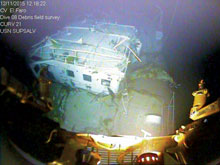 merchant marines for saving him from Jacksonville’s streets. LaShawn had two children and a fianceé named Vanna who was eight months pregnant. His family moved from Atlanta to Jacksonville when he was a teenager. He got picked on at Raines High School and started selling drugs. He spent a year in a juvenile detention center.
When LaShawn found out about the merchant marines, he spent every day down at the Seafarer’s International Union Hall, waiting for an opportunity. When he finally got one, he called his stepdad from London and said, “I’m never coming back.” Through the union, he took classes in cooking, tied back his dreadlocks and made for himself and his young family a life.
Danielle Randolph called El Faro a “rust bucket.” When the news came through to the bridge that Joaquin had become a Category 3 hurricane, with 130 mph winds, she shouted, “Hold on to your ass!” She said she was surprised Davidson wasn’t up here. Frank Hamm, a 49 year old “able seaman” of Jacksonville, predicted, “He’ll play hero tomorrow.” Joaquin would soon be a Category 4. The waves were 40 feet high.
Later, in El Faro’s final moments, the recorder captured the captain shouting, “Bow is down, bow is down!” before ordering everyone into the ship’s outmoded open-top lifeboats. “Everybody get off the ship!” he shouted. Hamm couldn’t move. “Follow me,” Davidson ordered, but Hamm said, “I can’t! My feet are slipping! I’m going down!” The blackbox recorded his last words: “I’m a goner!”
 Families of the 33 sailors, including five Polish repair workers on board because the ship’s owners wouldn’t lose profits by allowing downtime at port, all filed lawsuits against TOTE Maritime, which settled most of them. In 2016, TOTE approached Jacksonville City Council about installing a lighthouse statue and refurbishing bathrooms at the neglected city park beneath the Dames Point Bridge.
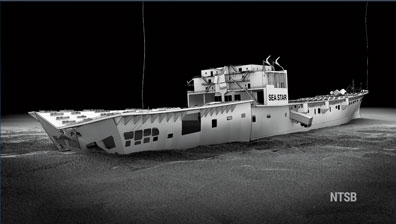
NTSB investigations faulted Captain Davidson, TOTE Maritime and the U.S. Coast Guard. El Faro lies about 40 miles from Crooked Island, Bahamas, three miles beneath the surface of the ocean, deeper than the Titanic. None of the bodies of the sailors were ever found. Once, back home in Maine, Danielle Randolph told her mother, “If I ever die at sea, that’s where I want to be.”